

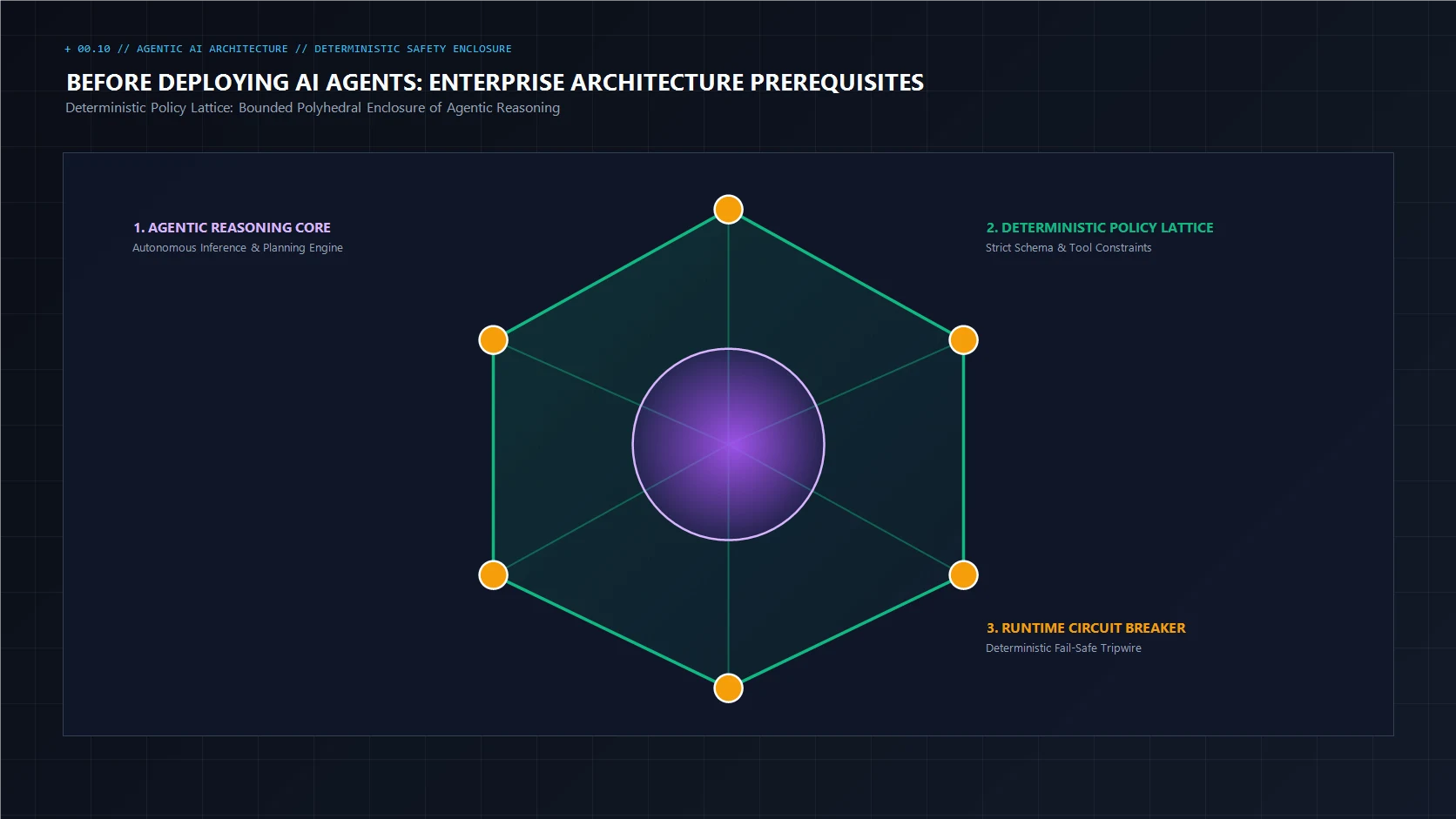
The Anatomy of Agentic Failure: The "Excessive Agency" Vulnerability
In traditional software architectures, business logic is deterministic. A program executes predefined instructions written by human engineers who have anticipated and tested specific control flows.
An AI agent, by contrast, operates probabilistically: it utilizes a large language model to reason over context and dynamically decide which tool or API to invoke at each step. If the model misinterprets an instruction, encounters an ambiguous API response, or suffers from prompt injection, it can enter a destructive execution loop.
The OWASP Foundation identifies this primary hazard as LLM06: Excessive Agency:
THE PATHOLOGY OF EXCESSIVE AGENCY
[ User Request or Injected Payload ]
│
▼
[ Autonomous AI Agent (Reasoning Loop) ]
│
(Unrestricted Tool Invocation)
▼
┌─────────────────────────────────────────────────────────────┐
│ UNFORTIFIED ENTERPRISE BACKEND                              │
│ - Over-privileged Service Account (Full Read/Write Access)  │
│ - Undocumented, Non-Idempotent APIs                         │
│ - No Human-in-the-Loop Confirmation Gate                    │
│ - Zero Step Limits or Execution Budget Controls             │
└─────────────────────────────────────────────────────────────┘
│
▼
[ CATASTROPHIC PRODUCTION MUTATION ]
- Bulk deletion of production database records
- Unauthorized release of sensitive customer PII
- Execution of cascading, irreversible financial transfers
Excessive agency occurs when an agent is granted capabilities, permissions, or autonomy that exceed what is strictly necessary to perform its intended task, combined with an absence of deterministic runtime guardrails.
To safely deploy agentic workflows, the enterprise must build a defensive architecture around the agent.
---
The 5-Layer Enterprise Agent Readiness Perimeter (BHR Code Analytical Model)
BHR Code requires enterprise clients to implement five structural layers of architectural defense before authorizing agentic production deployments:
THE 5-LAYER ENTERPRISE AGENT READINESS PERIMETER
├── LAYER 1: STRICT API SCHEMA HYGIENE & IDEMPOTENCY
│   └── Typed OpenAPI/JSON schemas, explicit error contracts, deterministic idempotency keys.
├── LAYER 2: SCOPED IDENTITY & LEAST-PRIVILEGE TOKENS
│   └── Ephemeral OAuth2 tokens, user-context propagation, task-bounded authorization perimeters.
├── LAYER 3: DETERMINISTIC EXECUTION SANDBOXES
│   └── Ephemeral, isolated container environments (gVisor/Firecracker); zero direct host network access.
├── LAYER 4: RUNTIME CIRCUIT BREAKERS & STEP BUDGETS
│   └── Hard limits on execution steps, token spend ceilings, and automated mutation tripwires.
└── LAYER 5: DECISION TELEMETRY & FULL REPLAY OBSERVABILITY
└── Comprehensive OpenTelemetry capture of inputs, chain-of-thought, tool calls, and API responses.
---
Layer 1: Strict API Schema Hygiene and Idempotency
Autonomous agents interact with enterprise systems through APIs. If your internal APIs are undocumented, return inconsistent error payloads, or accept ambiguous parameters, the agent's reasoning engine will fail.
Mandatory Architectural Requirements
- Machine-Readable Schema Contracts: Every tool exposed to an agent must have a strictly typed, comprehensive OpenAPI 3.1 or JSON Schema definition. The schema must include explicit field descriptions, regex validation patterns, enumerated value lists, and concrete examples. Agents reason over these descriptions to decide when and how to invoke the tool.
- Deterministic Idempotency: Agents frequently encounter transient network timeouts or retryable errors. If an agent calls a
processPayment()orupdateCustomer()API and receives a 504 Gateway Timeout, it will naturally attempt to retry the call. If the API is not strictly idempotent (enforced via unique transaction idempotency keys), the retry will execute duplicate charges or corrupt data records. Every state-mutating API exposed to an agent must guarantee idempotency. - Semantic Error Payloads: Traditional APIs often return generic HTTP 500 Internal Server Error codes. An agent cannot self-correct when given generic errors. Tool endpoints must return structured, semantically informative error messages (e.g.,
{"error": "INSUFFICIENT_FUNDS", "details": "Account balance $45.00 is lower than required $50.00; request cannot proceed."}) enabling the agent to adjust its execution plan intelligently.
---
Layer 2: Scoped Identity and Least-Privilege Authorization
A pervasive security antipattern in early agent prototypes is configuring the agent to use a single, shared "super-admin" service account with broad read and write permissions across corporate systems. If the agent is compromised or hallucinates, the attacker or errant model inherits total administrative control.
The Tri-Partite Identity Model
Enterprises must enforce a Tri-Partite Identity Architecture:
- User Identity: The authenticated human user on whose behalf the agent is acting.
- Agent Identity: The specific software agent and version executing the reasoning loop.
- Tool Identity: The target enterprise service being invoked.
When the agent invokes a tool, it must not use a static service account secret. It must present a short-lived, cryptographically signed OAuth2/OIDC access token that encodes the human user's fine-grained security context (User Delegation Flow). If the human user does not have permission to view a confidential payroll record or delete a customer account, the agent's API call must be rejected at the API Gateway level, regardless of what the agent's reasoning loop attempted to execute.
---
Layer 3: Ephemeral, Isolated Execution Sandboxes
When agents are granted the capability to execute code (such as Python scripts for data analysis, SQL queries for reporting, or shell commands for DevOps automation), executing that code on the host server or within a shared corporate network is a catastrophic security vulnerability.
All autonomous code execution must occur within Ephemeral, Isolated Micro-VMs or Sandboxes (utilizing technologies such as AWS Firecracker, Google gVisor, or Cloudflare Workers).
- Sandboxes must spin up in milliseconds for a single task and be permanently destroyed immediately upon completion.
- Sandboxes must have zero access to the internal enterprise corporate network; all required data must be passed explicitly into the sandbox via encrypted parameters.
- Egress network access must be strictly blocked or restricted via DNS whitelisting to prevent data exfiltration.
---
Layer 4: Runtime Circuit Breakers and Execution Step Budgets
To prevent an agent from entering infinite reasoning loops, incurring massive LLM token expenses, or executing runaway database modifications, enterprises must implement deterministic runtime controls outside the model's control:
RUNTIME CIRCUIT BREAKER CONTROLS
├── STEP LIMIT: Maximum 10 tool invocations per user task (hard abort if exceeded)
├── TOKEN SPEND CEILING: Maximum $1.50 in API inference cost per single execution
├── TIMEOUT THRESHOLD: Hard execution timeout after 120 seconds
└── MUTATION TRIPWIRE: Any action impacting >5 records or >$1,000 requires human authorization
These circuit breakers must be enforced by the execution orchestrator, completely independent of the agent's internal reasoning. If an agent loops repeatedly between two conflicting tools, the circuit breaker triggers, safely halting execution and escalating the session to a human operator.
---
Layer 5: Comprehensive Decision Telemetry and Full-Context Replay
When an autonomous agent makes an error, traditional application logs (which merely record that an HTTP endpoint was hit) are completely inadequate for debugging. Understanding why an agent made a decision requires full cognitive observability.
Enterprises must deploy unified tracing using OpenTelemetry semantic conventions for generative and agentic systems, capturing:
- The exact system prompt, user inputs, and few-shot examples provided to the model.
- The retrieved context documents and vector similarity scores from the RAG pipeline.
- The raw reasoning thoughts, tool-selection rationales, and intermediate steps.
- The exact JSON arguments passed to external tools and the raw payloads returned.
- Total token consumption, inference latency, and model version hashes.
This telemetry allows engineering teams to perform deterministic replay analysis: re-running a failed agent session in a test environment to identify whether the breakdown was caused by a flawed system prompt, ambiguous retrieved context, or an API schema defect.
---