
The Anatomy of Core Coupling
Monolithic cores resist modernization because their coupling exists across multiple architectural layers:
THE THREE TIERS OF MONOLITHIC COUPLING
┌────────────────────────────────────────────────────────────┐
│ 1. DATA-TIER COUPLING                                      │
│ Direct database reads/writes, shared stored procedures,    │
│ cross-table foreign key constraints, absence of API layers │
├────────────────────────────────────────────────────────────┤
│ 2. TEMPORAL & TRANSACTIONAL COUPLING                       │
│ Synchronous two-phase commit (2PC) calls, long-lived locks, │
│ unobservable batch processing dependency chains            │
├────────────────────────────────────────────────────────────┤
│ 3. OPERATIONAL COUPLING                                    │
│ Shared deployment artifacts, synchronized release windows, │
│ monolithic failure domains where one fault crashes all     │
└────────────────────────────────────────────────────────────┘
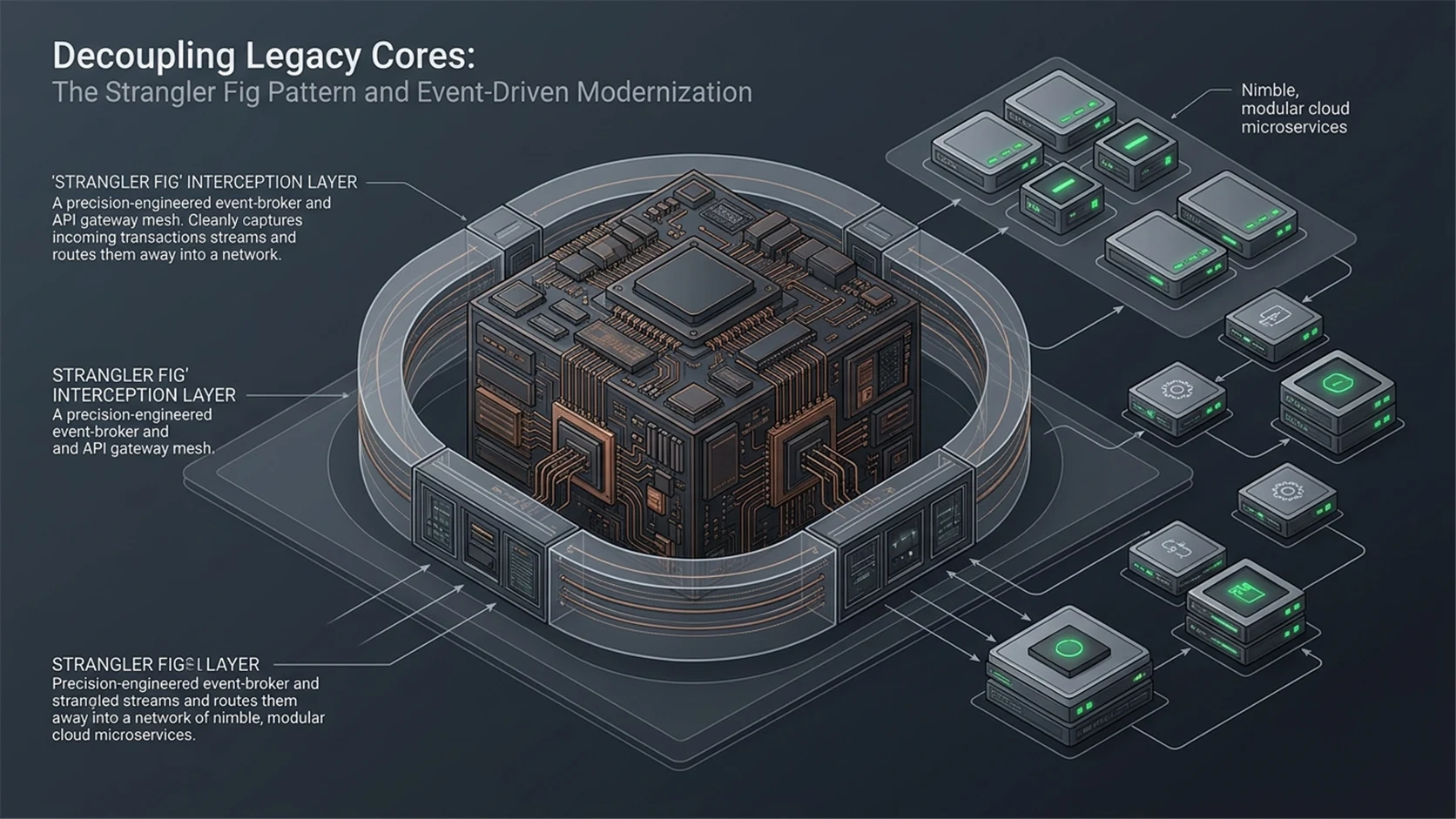
Attempting to rewrite the entire system simultaneously requires replicating thousands of undocumented edge cases simultaneously. In contrast, an incremental decoupling corridor isolates one bounded context at a time, establishing clear anti-corruption layers and data synchronization mechanisms.
---
EVIDENCE: Operational Failure Modes of Big-Bang Rewrites
Empirical delivery research and industry case studies demonstrate the extreme risk profile of big-bang legacy replacements:
- The Standish Group Modernization Studies: Longitudinal analysis in the CHAOS Report series indicates that large-scale software replacement initiatives involving legacy core transactional systems experience significant cost inflation or outright termination far more often than modular, iterative extractions.
- Architectural Literature on Incremental Extraction: In foundational architectural research, Martin Fowler documented the Strangler Fig Application pattern, establishing that the only reliably successful pattern for migrating mission-critical legacy systems is to gradually build a new system around the edges of the old, letting it grow over time until the old system is safely retired.
- ACM Queue on Event-Driven Modernization: Studies in distributed system reliability (e.g., Helland, Life Beyond Distributed Transactions: An Apostate's Opinion) demonstrate that replacing centralized two-phase locking with asynchronous event-driven state propagation and idempotent message consumers dramatically enhances overall enterprise system availability.
---
BHR CODE PERSPECTIVE • OPERATIONAL MODEL
The Five-Phase Legacy Decoupling Corridor
BHR Code structures core system decoupling across five controlled operational phases designed to maintain zero downtime and continuous data consistency:
THE FIVE-PHASE DECOUPLING CORRIDOR
├── PHASE 01: INTERCEPT & MEDIATE
│   └── Deploy API gateways and reverse proxies to intercept incoming client requests without touching legacy code.
├── PHASE 02: CHANGE DATA CAPTURE (CDC) REPLICATION
│   └── Tap the legacy database transaction log (non-intrusively) to stream real-time data mutations to an event mesh.
├── PHASE 03: SHADOW EXECUTION & RECONCILIATION
│   └── Route read/write requests to the new service in shadow mode; reconcile results against legacy output automatically.
├── PHASE 04: CANARY AUTHORITY SHIFT
│   └── Shift authoritative read and write traffic incrementally (e.g., 5% -> 25% -> 100%) to the new cloud-native service.
└── PHASE 05: RETIRE & AMORTIZE
└── Decommission the extracted legacy path, remove proxy shims, and reclaim legacy compute resources.
1. Intercept & Mediate (Anti-Corruption Gateway)
Deploy a high-performance API gateway in front of the legacy monolith. All client applications route requests through this facade. Initially, the gateway simply proxies 100% of traffic to the legacy endpoints. This establishes the architectural control point required to route future calls without modifying external client code.
2. Non-Intrusive CDC Ingestion
Directly polling legacy tables with scheduled queries degrades core database performance and fails to capture interim mutations. Instead, deploy Change Data Capture (CDC) engines (e.g., Debezium) that read the database transaction redo/WAL logs directly. Database state changes are published as structured event streams (e.g., via Apache Kafka) without imposing CPU overhead on the legacy transactional engine.
3. Shadow Execution & Automated Reconciliation
When the new microservice is deployed, route a duplicate copy of production traffic to it asynchronously. The new service processes the payload, and an automated reconciliation engine compares its outputs and database state against the legacy core's output. Any discrepancy in business logic, rounding rules, or state validation is surfaced and resolved before actual traffic cutover.
4. Canary Authority Shift with Circuit Breakers
Once reconciliation reaches parity, shift authoritative writes for a discrete subset of tenants or geographic regions to the new service. During this transition, write-back synchronization to the legacy database may be maintained as an immediate fallback safeguard. Automated circuit breakers detect latency spikes or error thresholds, instantly reverting routing to the legacy core if anomalies occur.
5. Systematic Legacy Decommissioning
Once the new service owns 100% of production traffic for that domain for a stabilized soak period, write-back adapters are removed, the corresponding legacy database tables are locked and archived, and unused legacy code paths are excised.
---
STRATEGIC OUTLOOK: Event Meshes and Agentic Integration
As enterprise architectures integrate autonomous agents and predictive models, the role of event-driven decoupling expands significantly. Clean, decoupled event streams provide the immutable telemetry feeds required to train, evaluate, and monitor operational AI workflows.
Over the next 24 to 36 months, legacy modernization will increasingly rely on semantic event schemas (such as CNCF CloudEvents) that abstract underlying infrastructure, enabling enterprises to swap underlying cloud platforms or database engines without altering consumer applications.
---
Leadership Lenses: Practical Guidance
For the VP of Engineering
- Forbid "big-bang" core replacement programs; mandate that any core modernization proposal include an incremental Strangler Fig extraction plan with defined rollback gates.
- Require automated CDC-based shadow reconciliation as a mandatory delivery milestone prior to shifting production write authority.
For the Enterprise Architect
- Define strict domain boundaries (Bounded Contexts) before writing code; do not attempt to decouple an arbitrary database table without isolating the entire business capability it supports.
- Establish standardized event schemas across the enterprise to prevent the event broker from degenerating into an unobservable "spaghetti" event bus.
For Principal Engineers & Squad Leads
- Ensure all new microservice consumers are strictly idempotent to handle duplicated or out-of-order event deliveries gracefully.
- Implement comprehensive distributed tracing (e.g., OpenTelemetry) across both legacy facade shims and new cloud-native services to diagnose cross-boundary latency instantly.
---