
The Productivity Paradox: Why Synthetic Velocity Stalls at the Enterprise Boundary
To understand why raw coding speed does not translate directly into business agility, leadership must distinguish between local developer activity and systemic organizational flow:
THE SYNTHETIC VELOCITY BOTTLENECK
[ AI Code Assistant ] ──(Generates Massive Code Volume)──► [ Developer IDE ]
│
▼
[ Stalled Production Pipeline ] ◄──(PR Review Gridlock / CI Debt)── [ GitHub Pull Request ]
- 48-hour human review queues
- High Change Failure Rate (CFR)
- Security scanning backlogs
- Undocumented architectural debt
- The Code Review Gridlock: When developers use generative tools to author 1,000 lines of code in minutes, someone must still review, understand, and approve that code. Because human cognitive bandwidth is finite, PR review queues swell. Recent engineering telemetry (DORA State of DevOps Report, 2024–2025) indicates that organizations deploying AI coding assistants without automated architectural guardrails experience up to a 35% increase in PR review latency.
- The "Copy-Paste" Architectural Drift: Generative models suggest code based on probabilistic patterns, not holistic awareness of an enterprise's specific architectural standards. As developers accept automated suggestions, subtle deviations in error handling, logging standards, and API contracts proliferate across microservices, silently inflating architectural technical debt.
- Software Supply Chain Vulnerabilities: AI-suggested code frequently introduces outdated or vulnerable third-party dependencies, hallucinated open-source libraries (package hallucination attacks), and non-compliant open-source licensing, placing immense strain on corporate security scanning pipelines.
---
The 4-Pillar Engineering Capability Stack for 2026–2027 (BHR Code Analytical Model)
To successfully navigate this landscape, BHR Code projects that high-performing technology delivery organizations will anchor their capability models around four structural pillars:
THE 2026–2027 ENTERPRISE ENGINEERING CAPABILITY MATRIX
├── 1. PLATFORM ENGINEERING & INTERNAL DEVELOPER PLATFORMS (IDPs)
│   └── Self-service developer portals (Backstage), golden paths, automated cloud provisioning.
├── 2. SYNTHETIC CODE GOVERNANCE & AUTOMATED GATING
│   └── Policy-as-code, automated contract testing, LLM security scanners, deterministic PR gates.
├── 3. OBJECTIVE DELIVERY TELEMETRY & SPACE FRAMEWORKS
│   └── Moving beyond commit volume to measure Flow Efficiency, cognitive load, and DORA stability.
└── 4. SOCIOTECHNICAL TOPOLOGIES & REDUCED COGNITIVE LOAD
└── Stream-aligned pods supported by dedicated platform and enabling teams (Team Topologies).
---
Pillar 1: Platform Engineering & Internal Developer Platforms (IDPs)
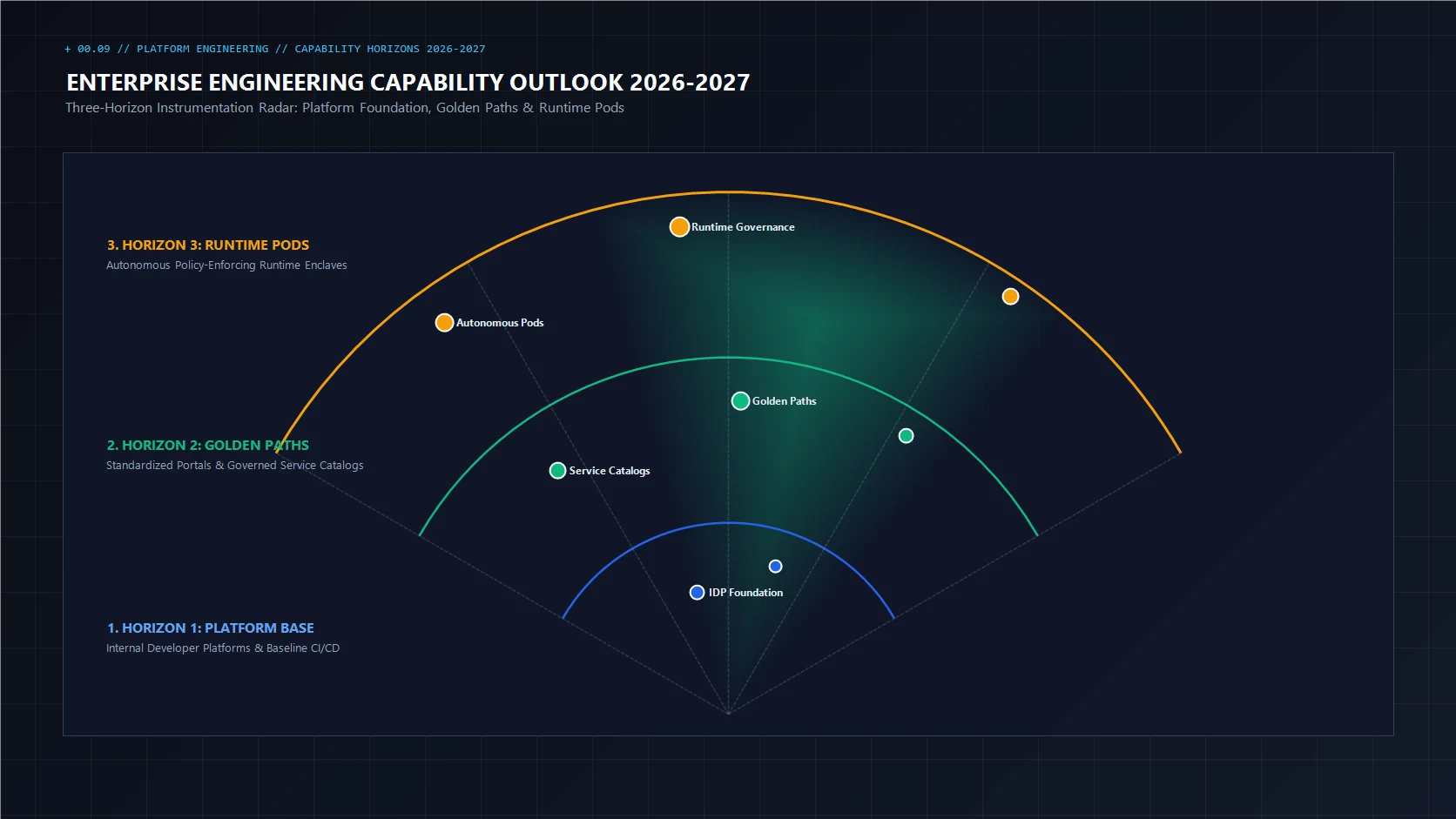
In high-performing organizations, infrastructure and deployment complexities are abstracted away from product engineers through Internal Developer Platforms (IDPs). Rather than forcing product developers to write complex Terraform scripts, configure Kubernetes manifests, and manually navigate IAM roles, the platform engineering team provides a standardized, self-service developer portal (such as Spotify's open-source Backstage).
Golden Paths Over Mandates
A "Golden Path" is a pre-architected, fully compliant template for creating and deploying a service. When an engineer scaffolds a new microservice via the IDP:
- Cloud infrastructure is provisioned automatically with pre-configured VPCs, encryption keys, and least-privilege security policies.
- CI/CD pipelines, automated testing suites, and container build configurations are pre-wired.
- OpenTelemetry observability, structured logging, and health-check endpoints are pre-instrumented.
Engineers are free to deviate from the Golden Path if specialized requirements exist, but choosing the Golden Path guarantees zero friction and automated compliance, dramatically lowering cognitive load.
---
Pillar 2: Synthetic Code Governance & Policy-as-Code
To prevent uncurated AI-generated code from destabilizing production, enterprises must establish automated Synthetic Code Governance:
- Automated API Contract Verification: Deploying consumer-driven contract testing (e.g., Pact) that automatically rejects any pull request that alters public API schemas or data serializations, regardless of whether the code was authored by a human or an AI assistant.
- Deterministic Architecture Linting: Utilizing tools like ArchUnit or Spectral to enforce architectural rules directly in CI pipelines (e.g., "Classes in the Domain layer cannot import classes from the Infrastructure layer"; "All outbound HTTP calls must be wrapped in a circuit breaker").
- Software Bill of Materials (SBOM) Enforcement: Automatically scanning every build against vulnerability databases to immediately reject packages with known CVEs or incompatible licenses.
By automating these objective architectural checks, human peer reviewers can focus their cognitive energy on higher-order questions: Does this business logic accurately solve the customer problem? Does this system design scale?
---
Pillar 3: Objective Delivery Telemetry (Beyond Vanity Metrics)
The debate over developer productivity has historically been plagued by misleading metrics: lines of code (LOC), commit frequency, or closed ticket counts. In an era where generative AI can produce thousands of lines of code in seconds, measuring LOC is as absurd as evaluating an aircraft's performance by how much fuel it burns.
Forward-thinking organizations adopt the SPACE Framework (Satisfaction, Performance, Activity, Communication, Efficiency), developed by researchers at Microsoft, GitHub, and the ACM:
| Telemetry Layer | Metric Focus | What It Measures | Target Indicator |
|---|---|---|---|
| System Flow | Flow Time & Flow Efficiency | The ratio of active work time to total elapsed time from idea to production. | Flow Efficiency >40% (eliminating idle wait states). |
| Release Stability | DORA Change Failure Rate (CFR) | The percentage of releases causing service degradation requiring rollbacks or hotfixes. | CFR <5% across all production deployments. |
| System Throughput | Deployment Frequency | Cadence of routine software releases to production environments. | Daily or continuous on-demand deployment. |
| Cognitive Health | PR Review Latency & WIP | Time code spends waiting for peer feedback; number of active tasks per engineer. | PR review median <8 hours; Flow Load aligned to team capacity. |
---
Pillar 4: Sociotechnical Topologies and Cognitive Load Curation
Technology architectures and organizational structures cannot be designed in isolation. As system complexity escalates, organizations that require software engineers to cover every layer (writing front-ends, tuning distributed databases, configuring Kubernetes clusters, and managing cloud security) inevitably encounter cognitive overload and execution paralysis.
The capability model of 2026–2027 organizes engineering into four distinct team topologies:
- Stream-Aligned Pods: Cross-functional teams dedicated to a specific business customer journey or product capability, empowered with full delivery authority.
- Platform Teams: Specialized systems engineers who build and maintain the Internal Developer Platform, treating stream-aligned developers as their internal customers.
- Enabling Teams: Deep-domain specialists (e.g., AI governance, cloud security, performance engineering) who temporarily embed with stream-aligned pods to upskill them on emerging capabilities.
- Complicated-Subsystem Teams: Highly specialized mathematical or algorithmic engineering teams dedicated to rare, complex domains (e.g., real-time cryptography or distributed consensus engines).
---