

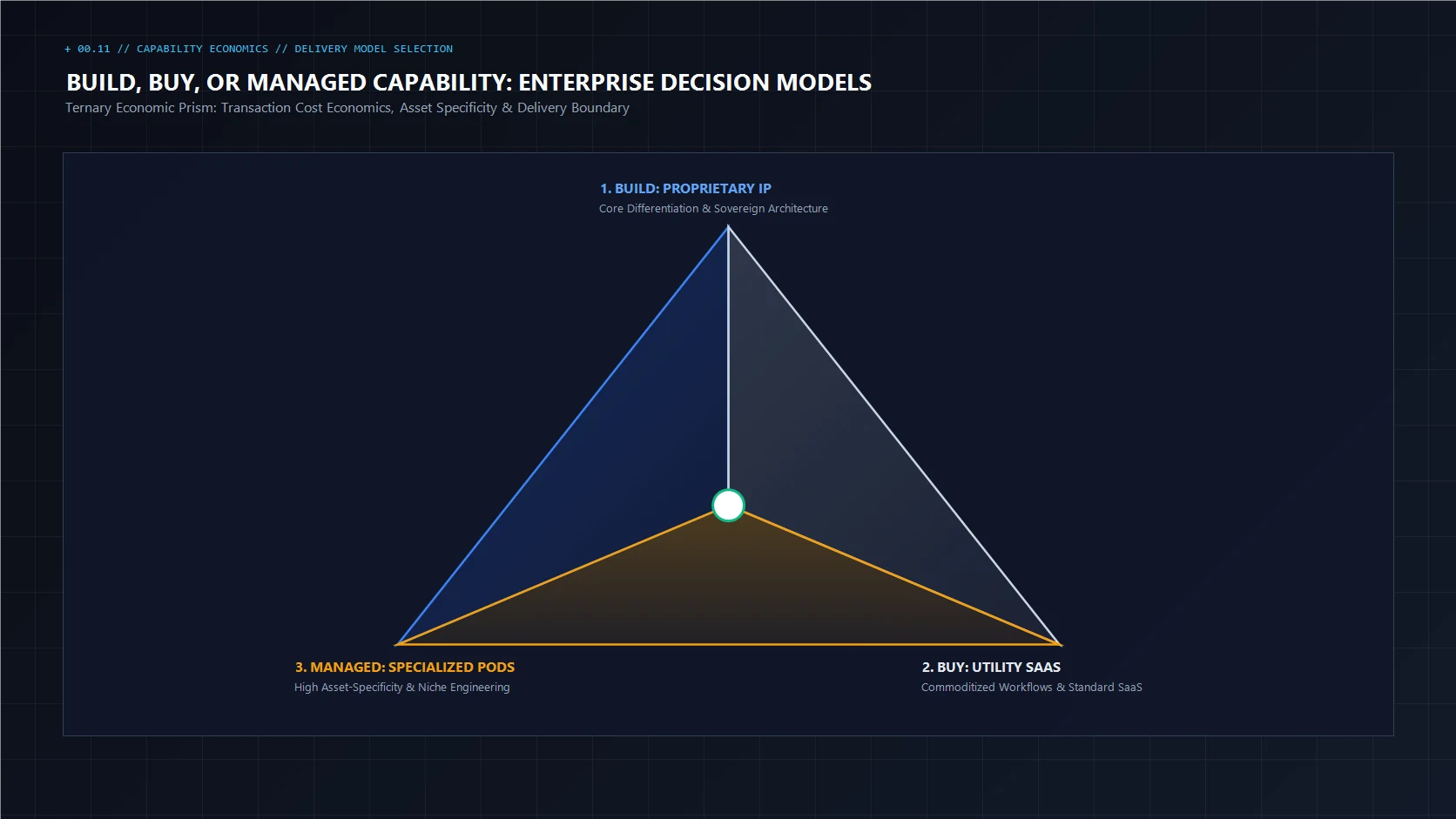
Deconstructing the Delivery Trilemma
To select the optimal delivery mechanism, executive leadership must analyze the structural trade-offs across the three dominant models:
THE ENTERPRISE DELIVERY TRILEMMA
[ 1. BUILD IN-HOUSE ]
/                   \
High IP Ownership       High CAPEX &
Total Control           Talent Scarcity
/                       \
[ 2. BUY COMMERCIAL SAAS ] ─── [ 3. MANAGED CAPABILITY ]
- Rapid Baseline Speed         - Dedicated Pod Velocity
- Zero IP Differentiation      - 100% Enterprise IP Ownership
- Compounding SaaS Tax         - Outcome-Linked Governance
| Dimension | Option 1: In-House Build | Option 2: Commercial SaaS (Buy) | Option 3: Managed Capability Pod |
|---|---|---|---|
| Strategic Focus | Proprietary competitive differentiator; core business secret sauce. | Commoditized, non-differentiating operational workflows (e.g., standard payroll). | Core platform modernizations, specialized digital channels, strategic acceleration. |
| Speed to Initial Value | Slow (6–18 months for recruitment, architecture, and deployment). | Rapid baseline (2–6 months), but slows dramatically during complex legacy integration. | Fast (30–60 days to pod mobilization; bi-weekly delivery increments). |
| Total Cost of Ownership (TCO) | High initial CAPEX; permanent OPEX maintenance burden on internal headcount. | Low initial CAPEX; compounding, unpredictable annual SaaS and integration fees. | Predictable milestone-linked operational expense; flexible capacity scaling. |
| Intellectual Property | 100% owned by the enterprise. | 0% owned; vendor retains all underlying IP and data architectures. | 100% owned by the enterprise; all artifacts and code transferred upon delivery. |
| Talent & Retention Risk | Borne 100% by the enterprise; high vulnerability to key-person attrition. | Borne by the vendor, but internal integration talent remains scarce. | Borne by the Managed Partner; pod SLA guarantees knowledge continuity. |
---
The BHR Code Sourcing Decision Matrix (Analytical Model)
To remove emotional bias from executive sourcing debates, BHR Code structures delivery evaluation across four objective criteria:
THE BHR CODE SOURCING DECISION MATRIX
├── CRITERION 1: ASSET SPECIFICITY & STRATEGIC DIFFERENTIATION
│   └── Does this system create unique market advantage, or does it execute a generic commodity function?
├── CRITERION 2: LIFECYCLE HORIZON & TRANSACTION FREQUENCY
│   └── Is this an enduring, 10-year core business engine, or a time-bounded 12-month transformation surge?
├── CRITERION 3: INTERNAL TALENT LIQUIDITY & SPECIALIZATION
│   └── Does the enterprise have the deep architectural expertise to hire, mentor, and retain these engineers?
└── CRITERION 4: ARCHITECTURAL INTEGRATION FRICTION
└── Will an external SaaS platform require extensive, high-risk refactoring of legacy transactional cores?
Rule 1: BUY When Asset Specificity is Low (Commodity Utility)
If a business process is identical across all competitors in your industry (e.g., employee expense reimbursements, enterprise email, standard general ledger accounting), BUY. Custom-building a generic ERP module or HR ticketing tool is an egregious waste of corporate capital. Adapt your internal business processes to match standard off-the-shelf software workflows, and resist all requests for bespoke customization.
Rule 2: BUILD IN-HOUSE When Asset Specificity is High and Talent is Core
If the software embodies the fundamental intellectual property that defines your enterprise's competitive moat (e.g., a proprietary algorithmic trading engine for an investment bank, an autonomous risk underwriting engine for an insurer, or a specialized routing algorithm for a global freight network), BUILD IN-HOUSE. Outsourcing your primary competitive differentiator erodes market advantage and transfers core institutional intelligence outside the firm.
Rule 3: DEPLOY MANAGED CAPABILITY for Strategic Acceleration & Platform Scaling
In the vast middle ground, where an initiative is strategically important and requires custom integration with legacy cores while internal hiring would take too long, organizations benefit from deploying managed capability pods.
A Managed Capability Partner does not provide low-level body-shopping or generic staff augmentation. The partner deploys a cohesive, fully functioning, multi-disciplinary engineering pod (Principal Architect, Lead Developers, Data Engineers, DevOps/SRE) governed by binding outcome milestones. The enterprise retains 100% ownership of the resulting code and IP, while the partner absorbs talent sourcing, retention, and delivery execution risk.
---
The Evolution of Managed Capability: Beyond Staff Augmentation
Historically, when enterprises sought external engineering capacity, they turned to traditional IT staffing agencies. This approach frequently created operational headaches: individual contractors had no shared accountability, required extensive onboarding, and lacked commitment to the enterprise's long-term architectural durability.
A modern Managed Capability model operates on fundamentally different governance mechanics:
STAFF AUGMENTATION vs. MANAGED CAPABILITY POD
┌──────────────────────────────────────┐  ┌──────────────────────────────────────┐
│ LEGACY STAFF AUGMENTATION            │  │ BHR CODE MANAGED CAPABILITY POD      │
│ - Billed on hourly timesheets (T&M)  │  │ - Billed against milestone outcomes  │
│ - Unconnected individual contractors │  │ - Cohesive, pre-integrated team      │
│ - Enterprise manages daily tasks     │  │ - Sovereign pod delivery accountability│
│ - High attrition and knowledge loss  │  │ - Guaranteed pod knowledge retention  │
│ - Vendor incentivized to drag time   │  │ - Partner incentivized for velocity  │
└──────────────────────────────────────┘  └──────────────────────────────────────┘
By contracting for delivered capability rather than billable hours, the enterprise aligns partner incentives with corporate velocity. If a feature is delayed, the commercial consequences are shared, creating a true delivery partnership.
---