

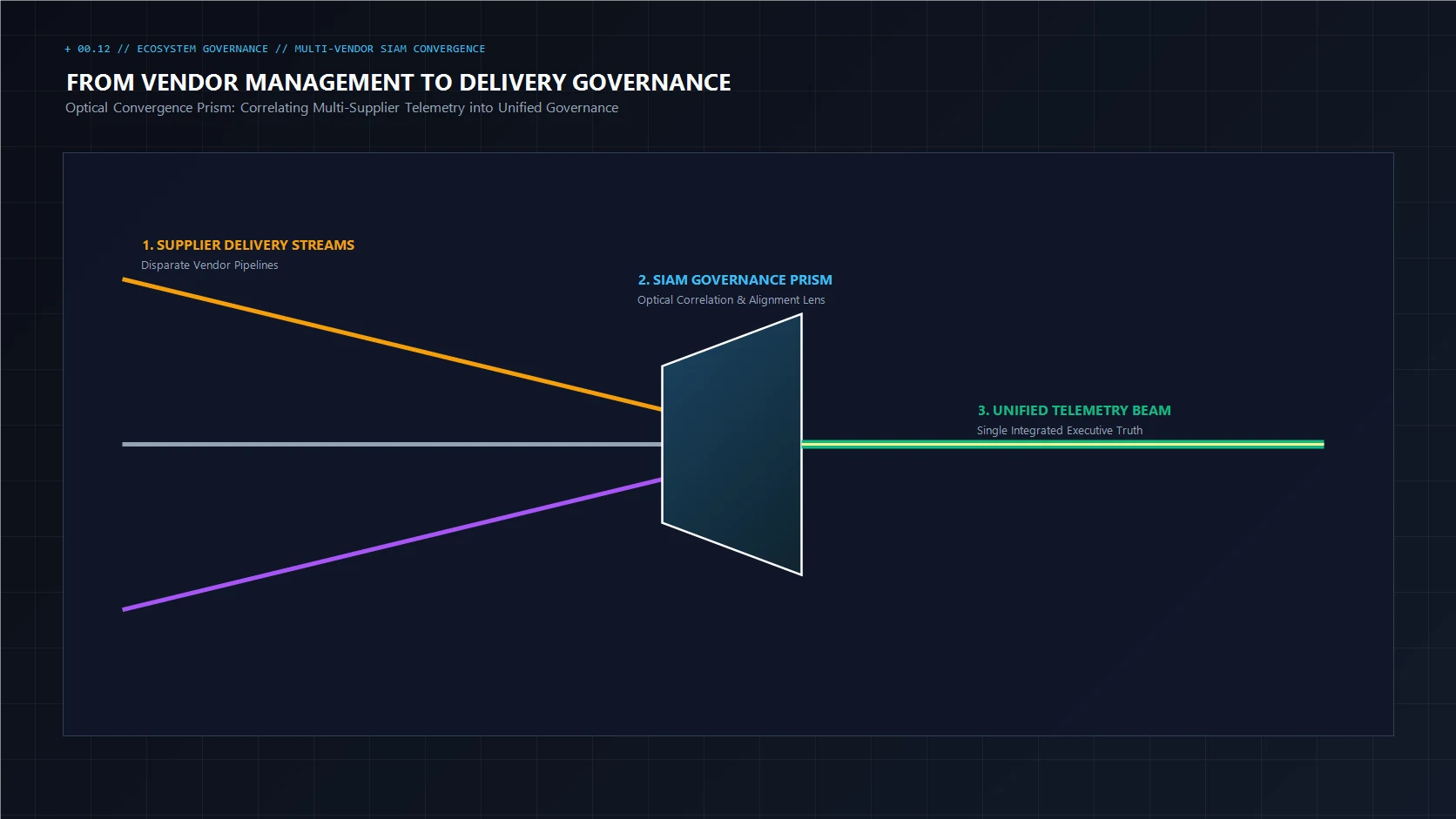
Why Bilateral Vendor Management Fails in Modern Software Delivery
Traditional enterprise procurement manages suppliers through Bilateral Contracting Silos:
THE BILATERAL CONTRACTING SILO ANTI-PATTERN
[ Enterprise Procurement / VMO ]
/             |              \
(Bilateral SLA)    (Bilateral SLA)    (Bilateral SLA)
/               |                \
▼                ▼                 ▼
[ Vendor A ]      [ Vendor B ]      [ Vendor C ]
│                │                 │
▼                ▼                 ▼
(Isolated Codebase) (Isolated Code)  (Isolated System)
└────────────┼─────────────┘
▼
[ COMPLEX RUNTIME INTEGRATION ]
(Unowned / High Friction)
In this model:
- Local SLA Optimization at the Expense of Systemic Flow: Each supplier is financially incentivized to optimize exclusively for their contractual metrics (e.g., closing tickets within 4 hours, completing tasks on time) rather than ensuring end-to-end software functionality. If helping an adjacent vendor resolve an architectural bug risks violating their own SLA, they will let the bug fester.
- Siloed Toolchains and Asymmetric Telemetry: Vendor A tracks work in their proprietary Jira instance; Vendor B tracks work in Azure DevOps; the enterprise uses ServiceNow. Because project telemetry is fragmented, cross-vendor dependencies are tracked through manual, out-of-date Excel spreadsheets reviewed during contentious weekly status meetings.
- Absence of a Sovereign Architectural Arbiter: When two vendors disagree on an API contract, data serialization standard, or security protocol, there is no vendor-neutral technical authority empowered to make an immediate, binding architectural decision. Issues linger in committee review for weeks, paralyzing engineering velocity.
---
The 4-Pillar Delivery Governance Architecture (BHR Code Analytical Model)
To eliminate cross-vendor friction and forge a cohesive delivery ecosystem, BHR Code structures multi-partner governance around four core pillars:
THE 4-PILLAR DELIVERY GOVERNANCE FRAMEWORK
├── PILLAR 1: THE SERVICE INTEGRATION & ORCHESTRATION LAYER (SIAM)
│   └── An independent delivery entity holding operational authority over cross-supplier flow.
├── PILLAR 2: THE UNIFIED PROGRAM VALUE STREAM & SHARED BACKLOG
│   └── A single, authoritative Jira/Git repository where all vendor tasks and dependencies live.
├── PILLAR 3: CROSS-SUPPLIER RELATIONAL CONTRACTING & SHARED AT-RISK POOLS
│   └── 15–20% of each partner's milestone billing is tied to collective, end-to-end program outcomes.
└── PILLAR 4: AUTOMATED CROSS-VENDOR DELIVERY TELEMETRY
└── Real-time CI/CD tracking of cross-partner API contract tests, PR review latency, and defect handoffs.
---
Pillar 1: The Service Integration & Orchestration Layer (SIAM)
Borrowing from the SIAM framework widely adopted across sophisticated European and global public-sector programs, the enterprise must separate Strategic Direction, Service Integration, and Service Delivery:
- Strategic Customer Layer (Enterprise Leadership): Owns business strategy, investment prioritization, and corporate budget.
- Service Integration Layer (SIAM Orchestrator): An independent, technically elite capability pod (either internal or an independent specialist partner) responsible for governing delivery flow, adjudicating architectural disputes, managing cross-supplier dependencies, and enforcing unified telemetry. Crucially, the orchestrator does not compete for downstream development work, ensuring absolute vendor neutrality.
- Service Delivery Layer (Specialized Partners): Systems integrators, cloud consultancies, and internal engineering pods executing bounded development tasks under the orchestrator's technical oversight.
---
Pillar 2: The Unified Program Value Stream and Authoritative Toolchain
Disparate vendor tracking systems must be strictly prohibited. As a condition of contract award, all suppliers must operate within the enterprise's authoritative delivery toolchain:
- Single Source of Truth: All user stories, epics, and technical tasks reside in a single enterprise Jira/GitLab workspace. No partner is permitted to present an external progress report generated from their own system.
- Explicit Dependency Mapping: Every cross-vendor dependency (e.g., "Vendor B's checkout service requires Vendor A's inventory API") must be formally modeled as a blocking link in the issue tracker. If an upstream vendor misses an API delivery commitment, the system automatically recalibrates downstream timelines and flags the delay in executive dashboards.
- Standardized Definition of Done (DoD): Establish a uniform, non-negotiable definition of done across all partners: code must pass automated unit tests (>80%), static security analysis, container vulnerability scans, and automated contract tests before being accepted into the shared integration branch.
---
Pillar 3: Cross-Supplier Relational Contracting and "Shared-at-Risk" Pools
To eradicate the "SLA Green, Program Red" paradox, the enterprise must align the commercial incentives of all participating suppliers.
Drawing upon relational contracting principles, modern Statements of Work (SOWs) must incorporate a Shared-at-Risk Milestone Pool:
COMMERCIAL INCENTIVE ALIGNMENT
├── 80%: Base Milestone Delivery (Paid upon individual technical component acceptance)
└── 20%: Collective Outcome Pool (Paid ONLY when the integrated end-to-end release passes UAT)
├── If Partner A delivers on time, but Partner B is struggling:
│   Partner A is financially incentivized to lend engineering capability to Partner B
│   because their 20% milestone pool is contingent on collective success.
When suppliers share commercial risk, their behavior fundamentally transforms: instead of finger-pointing, vendor architects actively collaborate to resolve cross-system bottlenecks, realizing that no individual partner gets fully paid until the complete integrated solution is operational in production.
---
Pillar 4: Automated Cross-Vendor Delivery Telemetry
Objective telemetry replaces subjective vendor status claims:
| Operational Metric | What It Measures | Target Governance Threshold |
|---|---|---|
| Cross-Vendor PR Latency | Hours an open pull request from Vendor A waits for review by Vendor B or Enterprise Architecture. | Median <8 hours; automated escalation if >24 hours. |
| Consumer-Driven Contract Violations | Automated test failures when an upstream API change breaks a downstream partner's integration. | Zero tolerance; CI pipeline immediately breaks and halts deployment. |
| Defect Ping-Pong Rate | Percentage of bug tickets bounced back and forth between vendors without code remediation. | Ping-pong count >2 triggers mandatory same-day joint architectural triage. |
| Flow Efficiency | Ratio of active development time vs. waiting on cross-supplier dependencies. | Target >35% flow efficiency across the multi-partner value stream. |
---