
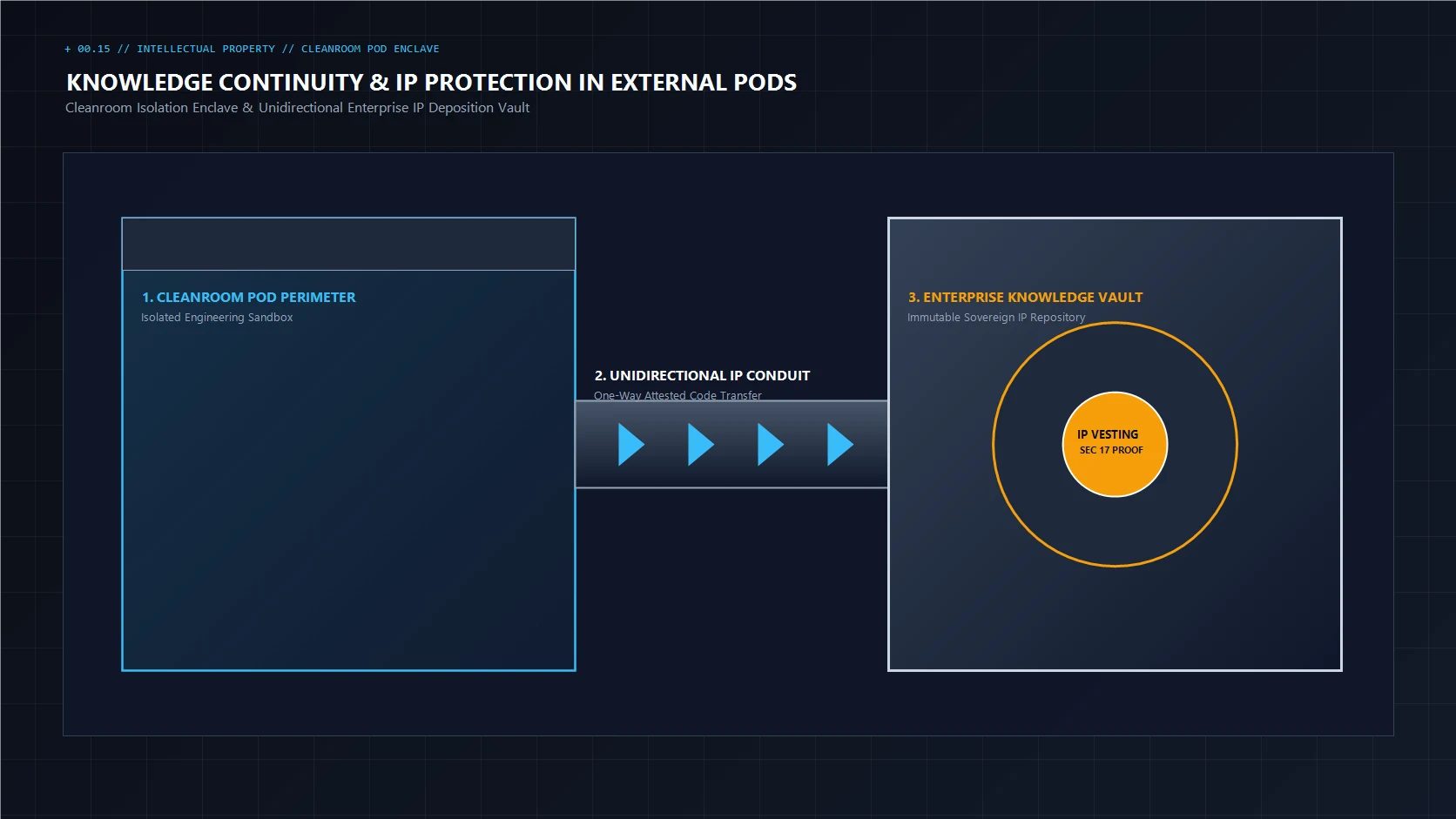
The Legal Perimeter: Ironclad IP Assignment & Clean-Room Hygiene
The foundation of intellectual property protection begins with non-negotiable contractual and licensing governance:
1. Real-Time Intellectual Property Assignment
Under copyright law in most common-law jurisdictions (including the United States and the United Kingdom), the legal doctrine of "Work Made for Hire" does not automatically apply to independent contractors or external corporate service providers unless explicitly assigned in writing.
Enterprise master service agreements must establish Real-Time, Unconditional Assignment:
- The contract must explicitly state that all copyrights, patents, trade secrets, and proprietary methodologies created during the engagement are the sole, exclusive property of the enterprise immediately upon creation (present assignment: "Vendor hereby assigns, transfers, and conveys...").
- Agreements must require the partner to secure identical written assignments from every individual developer, contractor, or subcontractor deployed on the pod prior to granting network access.
2. Open-Source Software (OSS) Hygiene & License Contamination
Developers frequently utilize open-source libraries to accelerate feature delivery. However, if an external developer incorporates a library licensed under a viral copyleft license (such as GNU General Public License - GPL v3, or Affero GPL - AGPL), legal precedent establishes that the enterprise's entire proprietary application may be legally compelled to be open-sourced.
Enterprises must implement automated Software Bill of Materials (SBOM) scanning in the CI/CD pipeline (using tools like FOSSA or Black Duck). The pipeline must automatically fail and reject any pull request containing:
- Copyleft or reciprocal licenses (GPL, AGPL, LGPL).
- Ambiguous or non-commercial licenses.
- Packages with unverified provenance or critical security vulnerabilities.
3. Identity and Zero-Trust Asset Segregation
External engineers must never be permitted to work on unmanaged personal laptops or store proprietary code on local hard drives.
- All development must occur within secure, enterprise-controlled Virtual Desktop Infrastructures (VDIs) or containerized cloud development environments (e.g., GitHub Codespaces / AWS Cloud9).
- Clipboard copy-paste, USB storage access, and external email attachments must be strictly disabled via Data Loss Prevention (DLP) policies.
- Source code repositories must enforce zero-trust access controls: external pods access only the specific bounded repositories required for their user stories, with branch protection rules preventing direct code pushes to production branches.
---
The Sociotechnical Architecture: Documentation-as-Code (Doc-as-Code)
Traditional corporate documentation practices rely on centralized wikis (Confluence, SharePoint, Notion). In fast-paced engineering environments, wikis fail completely:
- Wikis are detached from the code; when a developer changes a function or database schema, they rarely remember to update the wiki.
- Within six months, wikis become obsolete graveyards of misleading, outdated information.
- Developers stop reading wikis because they cannot trust their accuracy.
To establish permanent knowledge continuity, enterprises must mandate Documentation-as-Code:
THE DOCUMENTATION-AS-CODE ARCHITECTURE
┌─────────────────────────────────────────────────────────────┐
│ GIT REPOSITORY (Single Source of Truth)                     │
│ ├── /src/                 (Source Code)                     │
│ ├── /tests/               (Automated Test Suites)           │
│ ├── /docs/                                                  │
│ │   ├── /adr/             (Architectural Decision Records)  │
│ │   ├── openapi.yaml      (Machine-Readable API Contracts)  │
│ │   └── architecture.md   (Living C4 System Models)         │
└───────────────────────────┬─────────────────────────────────┘
│
▼
┌─────────────────────────────────────────────────────────────┐
│ CI/CD VALIDATION PIPELINE                                   │
│ - Verifies Markdown formatting and link integrity           │
│ - Automatically compiles HTML/PDF documentation portals     │
│ - Rejects PRs that alter architecture without an ADR        │
└─────────────────────────────────────────────────────────────┘
1. Architectural Decision Records (ADRs)
An ADR is a short, standardized text document (typically stored in /docs/adr/ in the Git repository) that captures an important architectural decision, the context in which it was made, and the trade-offs evaluated:
# ADR-0014: Adoption of Kafka Event Sourcing for Payment Ledger

## Status: Accepted
## Date: 2026-03-15
## Authors: External Delivery Pod (Lead Architect: J. Doe)

## Context
Our legacy SQL database cannot sustain the anticipated 5,000 TPS load during peak promotional events. We evaluated traditional database sharding vs. event-driven streaming.

## Decision
We decided to adopt an event-sourced architecture utilizing Apache Kafka as the immutable transaction log, with read models projected into Redis caches.

## Consequences & Trade-offs
- POSITIVE: Capable of scaling to 20,000 TPS horizontally.
- POSITIVE: Complete audit log of all financial state mutations.
- NEGATIVE: Introduces eventual consistency into account balance displays (typically <150ms). Downstream services must handle out-of-order events.
When an internal engineer inspects the payment system three years later, they do not need to guess why Kafka was chosen. The ADR provides complete historical context, eliminating architectural archaeology.
2. Automated Executable Documentation
- API Contracts: REST APIs and gRPC services must generate documentation automatically from code annotations (Swagger/OpenAPI). When an engineer updates an API parameter in code, the documentation is automatically updated and validated during the build.
- Living Test Specifications: Unit and integration tests written using Behavior-Driven Development (BDD) frameworks (Cucumber, SpecFlow) serve as executable documentation. A business rule is documented directly in the test: "Given an active customer account, when balance is negative, then reject transaction." If the behavior changes, the test fails.
---
The Structured BOT Offboarding Cadence: The 4-Week Reverse Shadow
When an external capability pod transitions a system to internal ownership, such as in a Build-Operate-Transfer (BOT) engagement, the handover cannot be a brief presentation on the final contract day.
BHR Code enforces a mandatory 4-Week Reverse Shadow Protocol:
THE 4-WEEK REVERSE SHADOW PROTOCOL
├── WEEK 1: SYSTEM DEEP DIVE & CODE WALKTHROUGHS
│   └── External pod conducts architecture walkthroughs; internal team reviews all ADRs.
├── WEEK 2: PAIRED ENGINEERING & DEBUGGING
│   └── External engineers drive; internal engineers pair-program and participate in code reviews.
├── WEEK 3: REVERSE SHADOW (INTERNAL TEAM DRIVES)
│   └── Internal engineers author 100% of pull requests and lead daily standups; external pod observes.
└── WEEK 4: AUTONOMOUS ON-CALL ROTATION & SIMULATED OUTAGE
└── Internal team takes over on-call pager duty; external pod triggers a simulated failure to verify response.
By Week 3, the internal team is writing the code; by Week 4, they are responding to production incidents. Only when internal engineers successfully diagnose and resolve a simulated system failure without external assistance is the commercial handover formally signed off.
---