

The Commercial Incentive Dilemma: Comparing SOW Paradigms
To understand why traditional contracts distort software delivery, leadership must examine how different contract types allocate risk and align behavioral incentives:
THE CONTRACTUAL INCENTIVE SPECTRUM
[ TIME & MATERIALS (T&M) ] ───────► Rewards Inefficiency & Headcount Expansion
- Risk: 100% on Enterprise        - Focus: Inputs & Timesheet Logging

[ FIXED-PRICE / FIXED-SCOPE ] ────► Triggers Adversarial Scope Freezes & Change Orders
- Risk: 100% on Supplier (in theory) - Focus: Contract Compliance over Software Utility

[ OUTCOME-BASED RELATIONAL SOW ] ─► Aligns Economic Interests via Shared Risk & Value
- Risk: Balanced Bilaterally      - Focus: Delivered Software Capability & Business Flow
| Contract Model | Billing Basis | Vendor Incentive | Enterprise Risk | Behavioral Consequence |
|---|---|---|---|---|
| Time & Materials | Hourly or daily rate per role. | Maximize billed hours; deploy junior engineers billed at senior rates. | Open-ended budget exposure; project delays. | Scope creep; bloated team size; relaxed delivery urgency. |
| Fixed Price | Lump-sum payment upon total project delivery. | Minimize effort; cut corners on testing and architecture; resist all changes. | Inflexible software that fails to meet evolving market needs; extensive Change Request inflation. | Adversarial negotiations; finger-pointing during acceptance testing. |
| Outcome-Based Relational | Two-tier: Base capacity costs (80%) + Variable outcome milestone pool (20%). | Maximize delivery velocity; optimize software quality to pass automated gates rapidly. | Predictable milestone-linked expenditure; shared delivery risk. | Collaborative engineering; proactive technical debt paydown; continuous alignment. |
---
The 4-Part Anatomy of an Outcome-Based SOW (BHR Code Analytical Model)
BHR Code structures outcome-based delivery agreements around four foundational legal and operational pillars:
THE 4-PART OUTCOME-BASED SOW FRAMEWORK
├── PART 1: BUSINESS CAPABILITY CHARTER & VALUE DEFINITION
│   └── Replaces granular task checklists with high-level business capabilities and user journeys.
├── PART 2: DETERMINISTIC POLICY-AS-CODE ACCEPTANCE GATES
│   └── Automated CI/CD verification thresholds (test coverage, security, DORA) triggering milestone release.
├── PART 3: TWO-TIER PRICING & SHARED-RISK POOLS
│   └── 80% base cost coverage + 20% milestone incentive pool tied to release date and performance.
└── PART 4: RECIPROCAL ENTERPRISE DEPENDENCY SLAs
└── Binding turnaround times for internal client approvals, test data provisioning, and environment access.
---
Part 1: The Business Capability Charter (Defining Outcomes Over Activities)
Traditional SOWs attempt to exhaustively enumerate every functional screen and database table. An outcome-based SOW defines deliverables as Business Capabilities and Value Stream Increments:
Example Contractual Clause: From Task to Capability
- Legacy Task-Based Framing (Avoid): "Supplier shall provide three (3) Senior Java Developers to author REST API endpoints for user authentication and transaction processing as directed by Client project manager."
- Outcome-Based Capability Framing (Mandate): "Supplier shall engineer, validate, and deploy an Idempotent Real-Time Transaction Processing Subsystem capable of orchestrating 1,500 transactions per second at <200ms latency, fully integrated with Client's core ledger and compliant with PCI-DSS 4.0 standards, as verified by automated acceptance gates."
By framing the deliverable around capability and operational performance, the partner is held accountable for end-to-end system utility rather than the mere provision of labor.
---
Part 2: Deterministic Policy-as-Code Acceptance Gates
The primary source of litigation and delayed payments in technology contracts is Subjective Acceptance Testing: the enterprise claims the software is "unacceptable," while the vendor claims it satisfies the functional requirements.
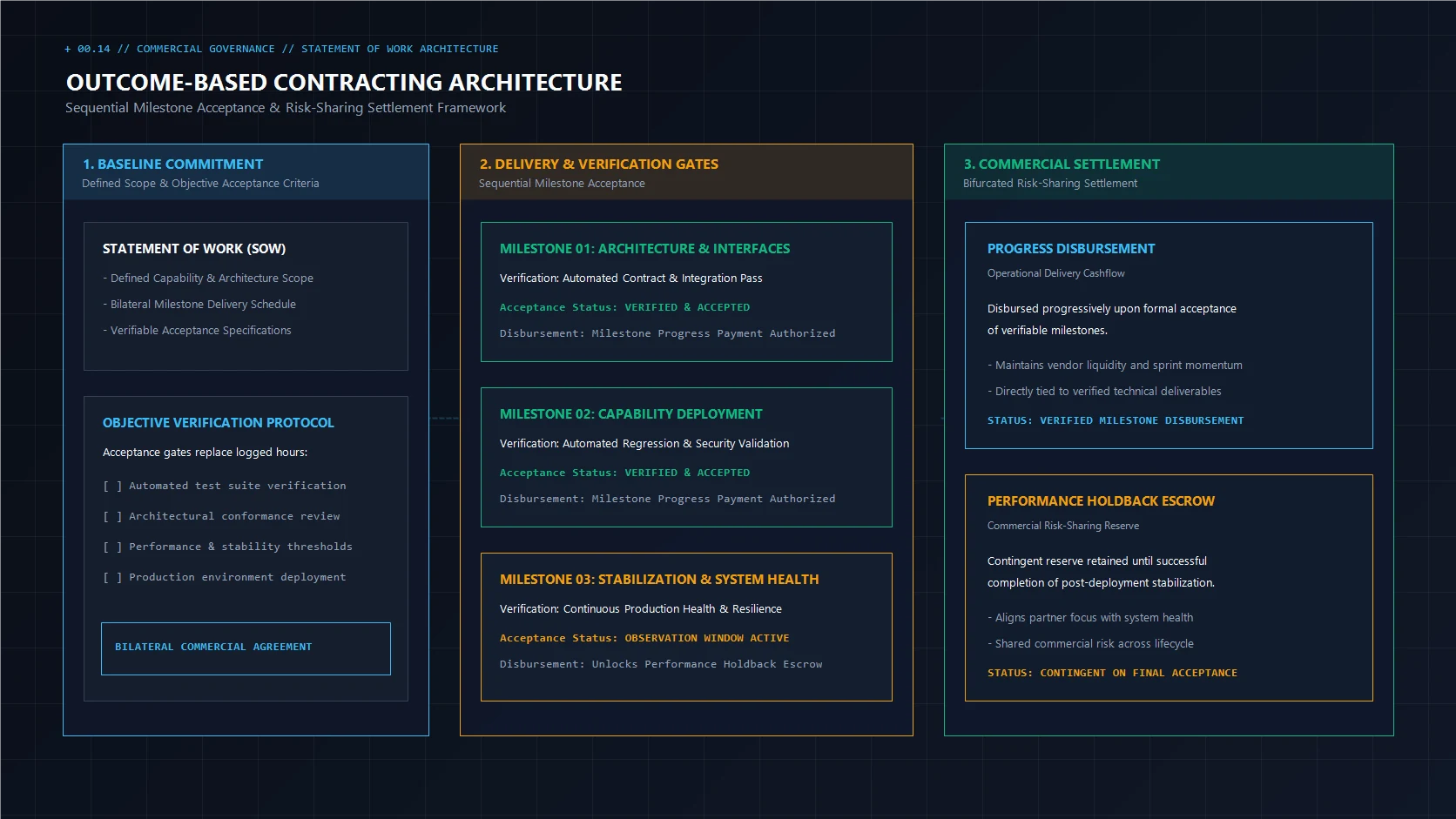
An outcome-based SOW replaces subjective human sign-offs with Automated Policy-as-Code Acceptance Gates embedded directly into the CI/CD pipeline:
DETERMINISTIC CONTRACTUAL ACCEPTANCE CRITERIA
┌─────────────────────────────────────────────────────────────┐
│ A milestone is deemed CONTRACTUALLY ACCEPTED when:          │
│                                                             │
│ 1. 100% of automated unit & integration test suites pass.   │
│ 2. Code coverage exceeds 85% as measured by SonarQube.      │
│ 3. Static Security Analysis (SAST) reports 0 Critical/High   │
│    vulnerabilities under OWASP Top 10 guidelines.          │
│ 4. Consumer-driven API contract tests execute with 0 errors.│
│ 5. Performance benchmark passes: 1,500 TPS under load.      │
└─────────────────────────────────────────────────────────────┘
When code meets these pre-agreed, machine-verified criteria, contractual acceptance is automatic and objective. Payment cannot be arbitrarily withheld due to internal executive politics, and the supplier cannot obscure substandard architectural quality.
---
Part 3: Two-Tier Commercial Pricing and Shared-Risk Pools
To achieve genuine alignment, the financial mechanics of the contract must balance economic fairness with performance accountability:
- Tier 1: Base Delivery Capacity (80% of Target Fee): Paid on a monthly or sprint basis to cover the partner's direct engineering payroll and operational infrastructure costs. This ensures the partner is not exposed to catastrophic cash-flow insolvency during complex engineering challenges.
- Tier 2: Outcome Milestone Incentive Pool (20% of Target Fee): Placed into an escrow or conditional billing reserve, released only upon successful verification of defined capability milestones against automated acceptance gates.
- On-Time / Target Quality Delivery: 100% of the milestone incentive pool is released.
- Accelerated Delivery with Elite Quality: A pre-agreed "Gain-Share" bonus (e.g., an additional 5% to 10%) is awarded if the partner delivers a validated milestone ahead of schedule, sharing the commercial value of earlier time-to-market.
- Unexcused Delay: The incentive pool decays linearly for each week of delay attributable to the partner, protecting the enterprise from paying full margins for late execution.
---
Part 4: Reciprocal Enterprise Dependency SLAs (Bilateral Accountability)
In enterprise delivery, vendor delays are frequently caused by client-side bottlenecks: waiting three weeks for security credentials, delayed stakeholder sign-offs, or unavailable test environments.
A legally robust outcome-based SOW must establish Reciprocal Operational Level Agreements (OLAs):
- The enterprise commits to specific turnaround windows (e.g., reviewing architectural spikes within 5 business days; provisioning staging cloud environments within 48 hours of request).
- If the enterprise fails to satisfy a binding dependency within the agreed window, the delivery timeline is automatically extended day-for-day, and any delay penalties on the partner's outcome pool are legally frozen.
Bilateral accountability transforms the relationship from a master-servant dynamic into a disciplined, professional partnership where both parties have clear obligations to maintain delivery flow.
---