

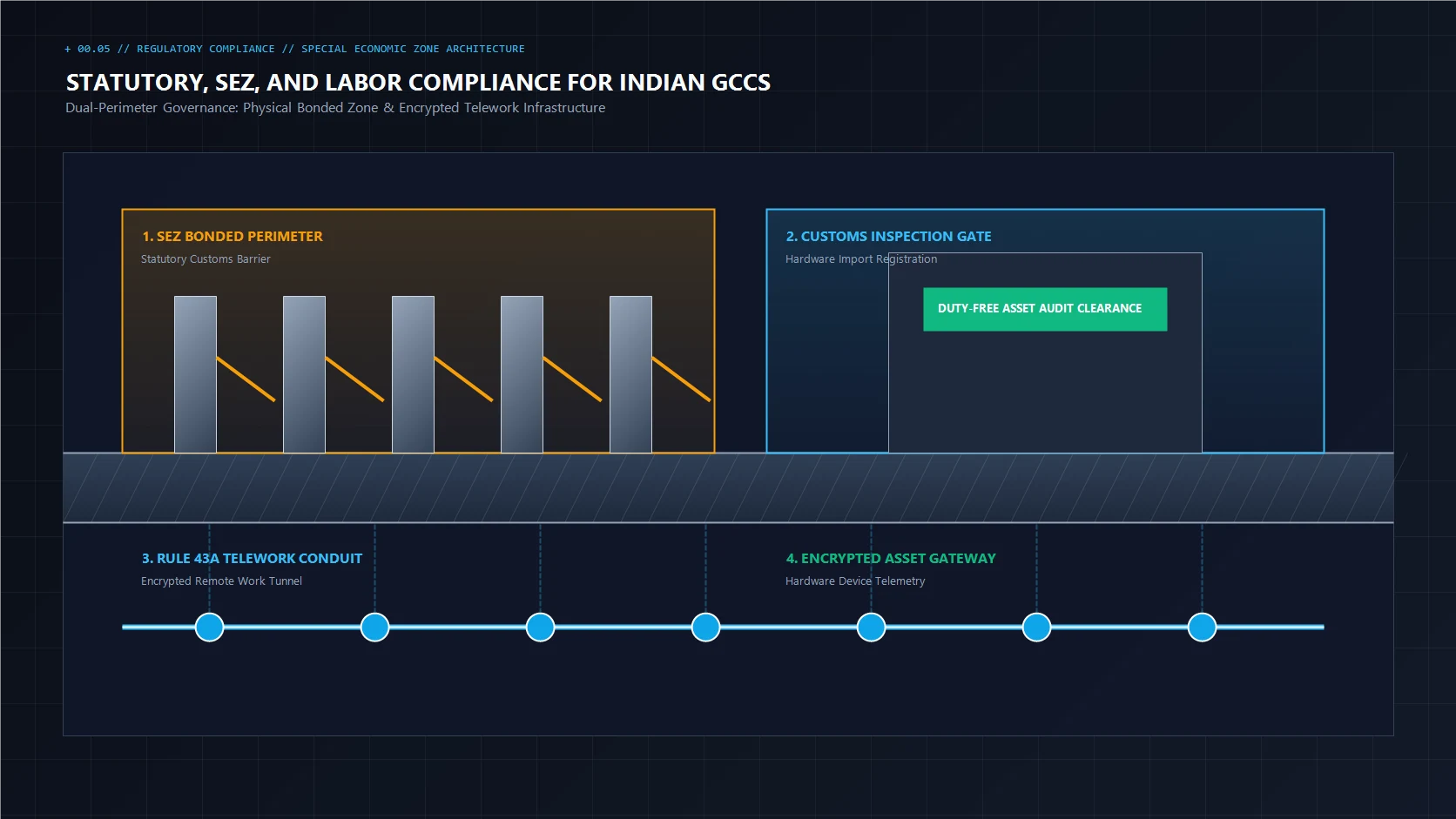
The SEZ Governance Perimeter: Navigating Rule 43A and Hybrid Work
A significant majority of multinational GCCs in India operate within designated Special Economic Zones (SEZs) to leverage fiscal benefits, streamlined customs handling, and duty-free import of enterprise hardware (servers, networking gear, specialized laptops).
However, duty exemptions are legally contingent upon physical asset custody and utilization within the bonded zone. When global enterprises adopted permanent hybrid working models post-2020, thousands of duty-free enterprise laptops were dispersed to remote domestic residential locations, creating severe customs compliance vulnerabilities.
To resolve this ambiguity, the Ministry of Commerce notified the Special Economic Zones (Fifth Amendment) Rules, 2023, codifying Rule 43A (Work from Home):
STATUTORY CONDITIONS UNDER SEZ RULE 43A
├── 1. COMPREHENSIVE ASSET TAGGING & LOGGING
│   └── Every laptop, desktop, or mobile device deployed outside the SEZ must be individually tagged with a unique serial number and customs entry record.
├── 2. EMPLOYEE VERIFICATION & ROSTER REGISTRATION
│   └── The SEZ unit must maintain an up-to-date digital register of all employees permitted to WFH, available for immediate inspection by the Development Commissioner.
├── 3. DOMESTIC TARIFF AREA (DTA) ASSET RESTRICTION
│   └── Assets cannot be permanently transferred or gifted; any decommissioned hardware must be re-exported or destroyed following formal customs clearance.
└── 4. SEZ DEMARCATION PROTOCOLS (Floor-Wise / Space-Wise)
└── Amendments permit partial de-notification of non-operational SEZ floors into non-SEZ IT spaces, subject to strict physical access segregation.
Operational Risk Warning
If an enterprise fails to maintain a real-time, digitally reconciled asset register matching physical laptop MAC addresses with SEZ customs import declarations, customs authorities possess the legal authority to deem those assets "unauthorized Domestic Tariff Area (DTA) diversions." This triggers retroactive customs duty demands, compounding interest, and penalties under the Customs Act, 1962.
---
The New Labour Codes: Operational Impact on High-Tech Capability Pods
The Government of India has consolidated 29 archaic central labor enactments into four comprehensive frameworks:
- The Code on Wages, 2019
- The Industrial Relations Code, 2020
- The Code on Social Security, 2020
- The Occupational Safety, Health and Working Conditions Code, 2020
While individual states are finalizing their respective draft rules, enterprise capability centers must proactively align their operational policies against three critical statutory provisions:
1. The 50% Basic Wage Threshold
The Code on Wages establishes a standardized definition of "wages," mandating that basic wages and dearness allowances must constitute at least 50% of an employee's total gross remuneration package. Historically, technology employers in India structured compensation packages with low basic pay (30% to 40%) and high allowances (travel, special allowance) to minimize statutory Provident Fund (PF) and gratuity contributions.
Enterprise Impact: Compliance will structurally increase employer PF and gratuity funding obligations, leading to an estimated 4% to 7% increase in statutory employee-related OPEX if gross compensation structures are not restructured.
2. Working Hour Caps, Overtime Governance & Shift Telemetry
Under the Occupational Safety, Health and Working Conditions Code, standard daily working hours are capped at 8 hours per day (48 hours per week). Any work performed beyond these hours constitutes statutory overtime, requiring compensation at double the standard wage rate.
Enterprise Impact: In engineering pods supporting global on-call rotations or participating in late-night cross-border release windows, informal unpaid overtime creates severe legal exposure. Capability centers must deploy auditable digital timekeeping systems that log on-call hours and automatically process statutory overtime payments to prevent wage disputes and labor inspectorate audits.
3. Female Workforce Night Shift Safety Mandates
Technology centers operating 24/7 global operations centers (NOCs/SOCs) frequently deploy female personnel on evening and night shifts (7:00 PM to 6:00 AM). The new codes codify statutory employer obligations:
- Mandatory, company-provided door-to-door GPS-tracked transportation.
- Deployment of trained security escorts for night-shift transit.
- Verification of driver background credentials and real-time transit telemetry.
- Zero-tolerance compliance with the Prevention of Sexual Harassment (POSH) Act, 2013, including mandatory Internal Committees (IC) and annual reporting.
---
Transfer Pricing Governance: Arm's-Length Margins and Permanent Establishment Risk
A multinational captive in India is a subsidiary entity that provides services to its foreign parent or affiliate entities. Because these transactions are between related parties, they are subject to intensive scrutiny by the Central Board of Direct Taxes (CBDT) under Section 92 of the Income Tax Act, 1961.
THE TRANSFER PRICING CHARACTERIZATION TRAP
[ Traditional Low-End Captive ] ────► [ Characterized as: "Low-Risk Contract Software Service" ]
- Safe Harbour: 17% – 18% Cost-Plus Margin
- Low transfer pricing dispute risk

[ Strategic High-Value GCC ]    ────► [ Risk: Tax Authority Recharacterizes as "Value Creator" ]
- Tax Department asserts entity contributes to core global IP
- Demands higher profit attribution (25%+ cost-plus)
- Asserts parent corporation has "Permanent Establishment" in India
Mitigating Transfer Pricing Litigation
To insulate the enterprise against retroactive multi-million-dollar tax adjustments, corporate leadership must implement two strategic legal mechanisms:
- Advance Pricing Agreements (APAs): Forward-thinking enterprises bypass subjective annual tax audits by executing a bilateral or unilateral Advance Pricing Agreement with the CBDT. An APA fixes an agreed arm's-length operating margin (typically between 16% and 18.5% cost-plus for software engineering) over a prospective 5-year period, with a 4-year rollback provision, establishing permanent fiscal certainty.
- Contemporaneous Functional, Asset, and Risk (FAR) Documentation: Corporate legal and tax teams must ensure that intercompany master service agreements (MSAs) and transfer pricing reports accurately describe the division of risks. If the Indian entity does not bear entrepreneurial or product market risk, contracts must explicitly state that all intellectual property ownership, market risk, and capital investment reside exclusively with the parent corporation.
---
The 3-Pillar GCC Statutory De-risking Perimeter (BHR Code Analytical Model)
To operationalize comprehensive compliance without introducing bureaucratic friction into agile engineering pods, BHR Code structures enterprise governance around three core pillars:
THE GCC STATUTORY DE-RISKING PERIMETER
├── PILLAR 1: ASSET TELEMETRY & SEZ GOVERNANCE (Customs & Logistics)
│   ├── Automated reconciliation: Active Directory device logs vs. SEZ customs entries
│   └── Documented de-notification and floor-segregation boundaries for hybrid teams
├── PILLAR 2: LABOUR CODE ALIGNMENT & SAFETY INFRASTRUCTURE (HR & Legal)
│   ├── 50% Basic wage restructuring in compensation bands
│   ├── Transparent digital on-call logging and automated overtime compliance
│   └── GPS-monitored night transit and auditable POSH committee records
└── PILLAR 3: TRANSFER PRICING & APA FISCAL CERTAINTY (Finance & Tax)
├── Rigorous Functional, Asset, and Risk (FAR) contractual definitions
├── Bilateral Advance Pricing Agreement (APA) filing for 5-year margin lock
└── Real-time compliance with CBDT Safe Harbour expenditure ceilings
---